
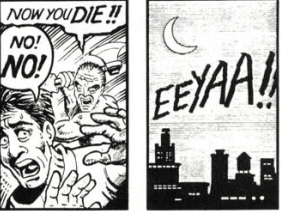
In Scott McCloud’s comic book Understanding Comics: Writing and Art the author Scott McCloud introduces the phrase Closure in the first panels of page 92 of the book. As he introduces Closure to us the readers he defines it as a reader’s ability to resolve the events in the space between a comic book or comic strips panels. McCloud on page 92 uses two comic panels that are inside one comic panel as examples for his idea of Closure in comics. The first panel of the two shows a man swinging at another man from behind with an axe, and in the next panel is a skyline of a city at night with a text bubble of a scream coming from the city. McCloud’s idea of Closure is our human ability to fill in what happens in the blank spaces or gutters between the panels. In the example given by McCloud most of readers including me would fill in the gutter with the axeman killing or harming the man he was swinging at. The conclusion that the axeman’s target was the man we see screaming would satisfy the insinuated sequence of events that occur between panel 1 and panel 2 in the gutter even though the results of the first panel are never shown. This is because the aforementioned conclusion is one of the most logical conclusions determinable with the information given to the reader.
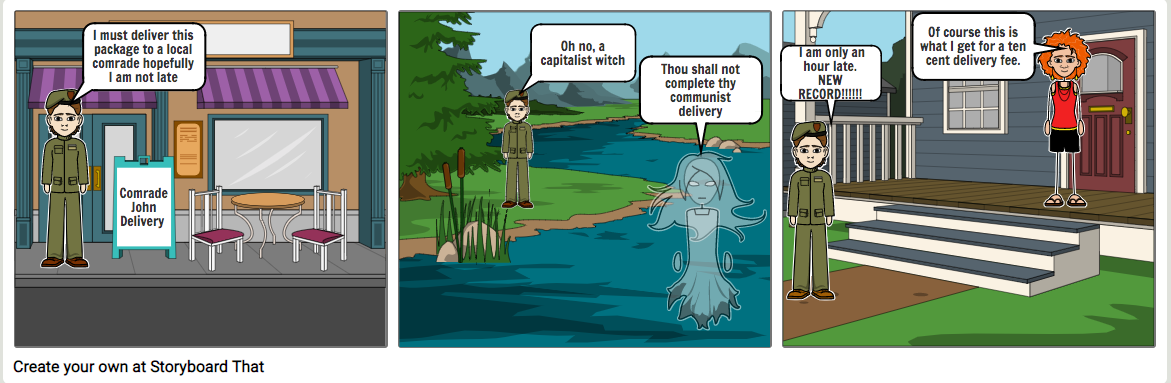
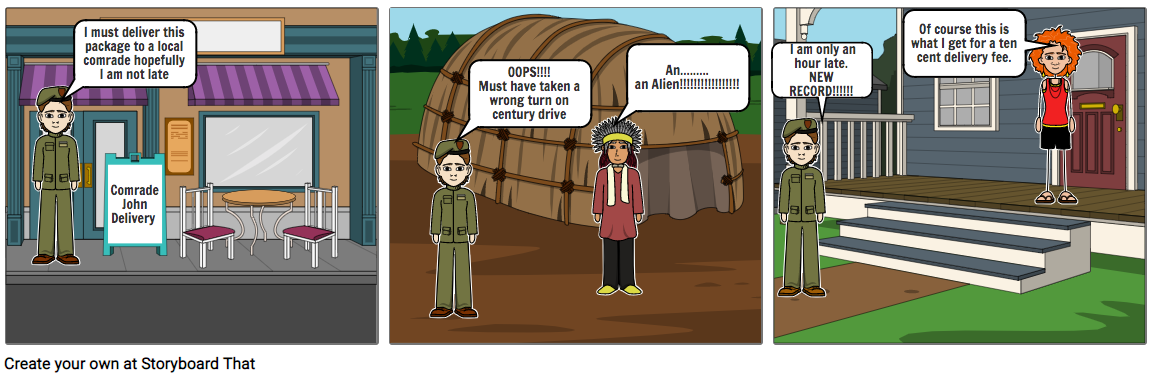
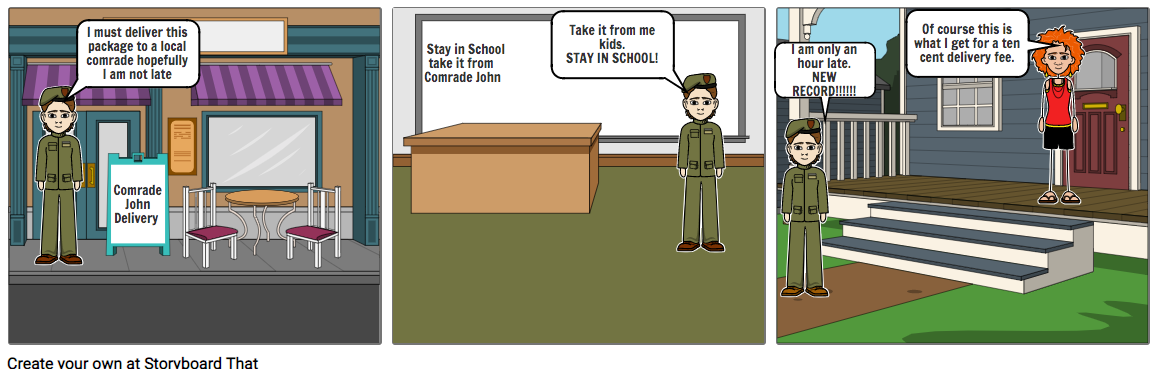
In my comic strips, the space for Closure within them is the reader trying to figure out how Comrade John got himself into those situations that always lead to him being late to deliver the packages that he was paid a meagerly ten cents to deliver to a fellow comrade. I don’t force an explanation of how John got into those situations. I left that up to the readers’ imagination and what they believe happened in the gutters of my comic strips.
Work Cited
McCloud, Scott. Understanding Comics: Writing and Art. Harper Perennial, 1994.
 Imperative